
As a way to show their support to gender diversity, WOM sponsors this Transition special and share their integration story with Amparo, who is part of their working team.
Ámbar – English
His name was Cristóbal and he was her first love. They were only five years old. Ámbar followed him to the bathroom and cheerfully looked at him while they played. Ámbar dreamed of hugging him and kissing him. But Ámbar, who was Diego back then, asked himself alone: “Why do I like a boy?” It wasn’t normal to feel that, considering he had a mother, a woman, and a father, a man. “Maybe it’s because I’ve always felt like a girl,” she thinks now, with 22 years old, sitting in a café in Providencia.

She straightens her reddish-brown hair every so often, partly taking care of it, and partly showing it off with a flawless, but subtle makeup. On a cool August afternoon, she wears a short, tight crop top leaving her navel and arms uncovered. And no, she doesn’t feel cold, she always was “sort of hot-blooded,” she says, and laughs, as cheerful as that child in love at kindergarten. She stops the conversation and eats a slice of pizza.
Nicole Murillo,

Diegui the rebel
Ámbar was always Diegui to everyone, never Diego. She drew her name with pink pencils. At the age of six and seven, she posed in the pictures imitating her aunts and her idols, Shakira, Britney Spears, and Thalía. She thought they were gorgeous and wanted to be like them. She liked to watch Rebelde, a Mexican soap opera where schoolgirls wore leather boots, tiny skirts and a lot of makeup. Being drawn to all these feminine things gave her pleasure, but also a huge frustration.

Entering school was the confirmation of this feeling of discomfort. “I was discriminated in first grade because I was too feminine for my things.” They called her “the gay boy,” but her teachers protected her and scolded the classmates who bullied her. “They tried to stop the
“I said ‘No’ to everything, I misbehaved badly and I had around five sheets of negative entries in my Classbook. I think I needed to find myself,” says Ámbar, trying to find an explanation for her behavior. Sometimes she dreamed of going to sleep and waking up as a woman, and other times, almost as if she were contenting herself with it, the dream was different: she woke up and was attracted to women. When she was 11 years old, during sixth grade, she says she finally “accepted it.” “I said to myself, I’m gay.”
She was kicked out of school the following year.
She began attending another school in March —“the one that accepted me.” There she met other gay boys and “I came out of the closet big time,” she says. She was turning into a teenager and her relationship with her mother began to become strained. “My mom suffered a lot; not much because I was feminine, but because I used to hang out a lot.” She gave her permission to go out one day during the weekend, but Ámbar vanished on Friday, Saturday and even Sunday. She drank and smoked too much. Looking back, she thinks her search turned into self-destruction.
Although she had kissed some boys before, and even had some girlfriends, “whom I disgusted kissing,” it was at that time when she began to have her first relations with men. When she was 14, she remembers having a boyfriend where their relationship lasted about a year.
“Diego, are you gay?” asked her mother from time to time. “No, Mom,” answered Ámbar over and over again. His head echoed “Tell her, tell her you’re gay,” but she was too afraid to utter those words. Even after accepting her homosexuality, and having told herself that she didn’t care what anyone else thought, and whether her family supported her or not, she was not ready for that kind of exposure.
Until one day, when she was 15 years old, her mother asked her for the last time:
- Diego, are you gay?
- Yes, Mom, I’m gay.

Ámbar left her mother’s house, where she lived with her two sisters, and went to live with her grandmother from his mother’ side, Juana María. At her mother’s, she secretly cross-dressed —wearing her elder sister’s clothes, her mother’s heels, and a towel on her head,
“I tightened the whole thing, from the socks to—I don’t know—the shirt; all was tightened. Yes, tight shirts, very tight T-shirts and pants like leggings. I tightened them by hand myself, and my mom would tighten them sometimes for me using a machine.”

When she had freed herself from everything she could, she had a change of heart. She wondered whether she should try to be a ‘man.’ “If fate had made me
“It wasn’t my thing. It didn’t really work out. I didn’t feel like myself.”
She failed her penultimate grade of secondary education thrice, the last time on purpose, and finished her secondary education by completing two years in one when she was 18 years old. Those were complicated times for Ámbar. She had a hard time finding a job because she looked too feminine. She then found some YouTube videos where Mexican trans girls showed their transition on a monthly basis and the effect hormones had on their bodies. She says that it was only then she knew what being a transgender was like. “I didn’t want to be a man dressed as a woman and I didn’t know I could take hormones.”

It took her two years to figure out what she wanted to do. She wondered what her parents would say, what would happen if she regretted her decision. She didn’t want to go to a psychologist. Finally, she asked herself, “Ok, Diego, what do you want to be? Do you want to be a woman or do you want to be a gay boy?” “And I chose to be a woman.”
Certificate in hand
Ámbar’s mother had a dream. “A couple of days ago, I dreamt that you were going to get breasts,” she said the day Ámbar told her that she was a transgender. She was carrying a certificate from her counseling that the psychologist had given to her. “I needed support, so they wouldn’t think this was a prank, something temporary, like being a Pokémon.” (a former urban tribe from Chile, not the videogame.) Ámbar cried, followed by her mother, and then her younger sister. They told her they were going to support her and then she began her transition.

She made an appointment with an endocrinologist recommended to her, in a private medical center. “Because I would have waited a year to have an appointment with him if I had made the appointment through the public health system,” she says. Her father, who lives in Calama, has paid for her consultations and tests, but she has paid for the hormones. While he has always supported her from a financial standpoint, he has had a hard time accepting Ámbar’s transition. “He told me that my ass was mine and that I could do whatever I wanted with it —he was not going to interfere with what I wanted to be.”
Ámbar returned to her mother’s house, but she visits her grandmother from time to time to celebrate the progress of her treatment and the changes she is noticing. She feels that she has changed a lot, but she knows that she still has a long way to go. “I think only in two years I’ll be seeing more dramatic changes.” She feels sensitive at times, “like when women have their periods,” and she cries over “silly things.”
Currently, Ámbar is not working. She says she is “focused on her well-being
“It’s hard to find work like this. It was difficult already when I was a ‘feminine boy’, but now it’s even
After waiting for four months, in August, she underwent an expert psychological and sexological assessment before the Legal Medical Service (SML). The whole procedure is such a bummer for her, but above all “it’s pretty much as having to certify that you are not fucked-up so they allow you to change your gender, even though I feel like a normal person, with all my abilities intact.”
- What other changes do you want to make?
- I want to get breasts and a rhinoplasty. And then, giving me a treat, like getting a butt lift, something like that.
- And a genital transformation surgery?
- I don’t want to have sex reassignment surgery. Having a penis doesn’t make me any less or more of a woman, really. I like belonging to a third gender. Becoming normal, a binary woman, with vagina is no fun. I like being like this, to be more exotic, more eye-catching.
There is a challenging tone in Ámbar’s words. She says that she is aware that many people can tell that she’s a trans kilometers ahead and so what. She does not want to “go unnoticed,” she wants people to think she’s a woman, but she also wants them to know she was a man before. This has gotten her into trouble. They hardly yell “gay” or “fag” at her anymore, but they harass her now instead. “I’ve been followed by guys masturbating, I’ve been offered sex many times on the street —One night, while I went back home, a guy grabbed me from behind and acted as if he was going to rape me.”
- What did you do?
- I gave him a blow. He was so shocked that he went away and left me alone.
- Were you afraid?
- No fear. If they shout things at me in the street, I’ll face them again. Let them say it to my face. And if they want to hit me, let them hit me, I don’t care.
Many things have changed, but Ámbar is still as rebellious as Diegui.


Katty – English
While walking down the 10 de Julio, looking for a drugstore that didn’t exist, Katty took her first steps across the streets of Santiago as a woman. On December 29, 1968, she was 18 years old, and as a gift she had received a skirt and high heels shoes. Because she still had short hair, she could barely make a bun. She went unnoticed among the passersby, in a strange rite of passage invented by the transvestites of the San Camilo neighborhood.
“They wanted to see what happened to me, whether they caught me or not. They regretted it later, as they were concerned that something would happen to me; that I would be taken to jail.”

Katty started dressing like a woman at night. In the
Harold Free
Katty’s life is shrouded in an epic halo. She’s one of the “historic” trans. She says she was at the first disturbances from 1973, months before the coup, when there were no organizations, no human rights, no children’s rights, gay rallies, nothing. Only few of that generation are still alive when she makes the counting. She is the voice that persists.

“I am tough, a tough one.”
She was from the countryside, from Curicó, and says that her father was the city’s Mayor: Arnoldo Parra Donoso. Her mother, she adds, was a community worker of the municipality, Ms. Luz Eliana González Apablaza. She had a distant relationship with both of them; the only thing she longed from her mother was her clothes, which she wore in secret. Berta, the nanny, scolded her. She told her to go play soccer and play with his marbles.
But she didn’t like sports. She only watched her classmates play soccer because she enjoyed looking at their legs. “I always liked men.” She had the hots for her dad’s driver, she says. “I seduced him. He was so handsome. I hugged him, tried to kiss him. Then, we were intimate.”
She was 11 years old.
Everyone found out, she says. It was a scandal, her father wanted to kill her. “He shot me all over Curicó square at night.”
- Katty, how do you explain that there are no historical records showing that your dad was mayor of Curicó? There are no records of any Arnoldo Parra Donoso as mayor of that city, ever.
- Who knows, I don’t know why is that, my dear. There was no computer back then. I can’t think of any explanation, I don’t know. As I’m telling you, it was for the World Cup of 1962.

The 1962 World Cup (held in Chile) is the date that, in Katty’s memories, was a turning point in her life. Her father sent her to Santiago with Berta, the nanny. “He had a house in Cervecería Unida, around Vitacura. That’s where I grew up and went to primary school No. 44.” She never saw her family again. “For them, I was already dead.”
Upon entering secondary school, the school José Victorino Lastarria, Katty says that she “came out of the closet big time.” When she was in her third year of secondary school, she was caught having sex with the Principal’s son in the gym and got expelled. But she wasn’t going alone: “I blew the whistle on two other boys, Erasmo and
They called Berta to go pick her up, but Katty ran away with the other two boys, and Larry, the Principal’s son. “The four of us went to Alameda to walk around the city, then to the park, in Providencia. We hung around asking for money, so we had everything we needed.” Eventually, the police caught them. The Principal’s son returned to his family. Nobody went looking for her. She ended up in the National Home for the Child (Casa Nacional del Niño), but she ran away from there too.
“Of course, I was gay. A fag, a faggot, a poof. In other words, I liked men. The more women-like a homosexual was, the more popular he was among the manliest men.
In downtown Santiago, between Posta Central and Plaza de Armas, Katty began to make her group of friends—“The Girls,” which was formed by Milenka, Bambi, Papi, Doc (
Sometimes the police arrested them for “
She says that Doc —a famous transvestite from street San Camilo— left her at the soda shop El Bosco, while she went to take care of her customers. “She would buy me a cup of coffee and I would wait for her. I wasn’t good at flirting.” One day, Doc finally took her to the brothel, Katty says. Since she was a minor, she was not accepted. Jorge, a pimp, received her in his house. In return, she cleaned the women’s room, swept the living room, and did the shopping.
A girl told her that she was not going to earn much money by doing errands and started “working as a maid.” The homeowners gave her a room, breakfast and lunch. “They took you as part of the family.” Sometimes they had to run away, because the police closed the block to raid the underground establishments.
– Don’t be silly! If they are such scumbags with the real women who give them children and everything, just imagine how they would be with someone like me, who is never going to give them a future, a child, nothing.
It was the time of the bohemian night, she recalls. She took classes with Paco Mairena, a choreographer at the Bim Bam Bum theatre. “He and Sergio Lesica, another choreographer, called me
Katty spent her time moving around the nightclubs of the North of Chile with the Royal Travesti Ballet.
- Did you always like dancing?
- I don’t know, why should I lie to you, the thing is that I had to survive.
The coup, she says, forced her to do a pause. She lived with a thief who was killed in 73, she says. She sold everything she had and ran away to Mendoza, where she worked as a maid. She then traveled to Buenos Aires. She dared to return to Santiago in 1976. “They used to tell us that terrible things had happened, many deaths, murders. All the homosexuals with an ugly record were killed.”

Madame Fontey
“I made myself,” says Katty, who is about to turn 68. She bought Peruvian hormones in Arica; in Tacna, a pair of breasts. “I just implanted a little on myself.” She never went to a doctor, she learned how to do it herself by reading, “but I used only sterilized equipment. I’m not a nutjob at all. A paramedic friend would take care of me in the hospital.”
She managed to have surgery in 2000 and changed her identity card just a few months ago, much later than most of her friends. She says that having surgery meant being born again. “Sex changes started under Pinochet’s regime. You needed the sex change in order to be able to change your name. All of us wanted to be a respected person, a lady, raise

Upon her return to Chile in 1976, she settled in Talca, because “there were brothels there.” She spent some time at the Zepellin, a city night club. During the dictatorship, she says, the bohemian night “got complicated.” At that time, Circus Show like ‘el Timoteo,’ emerged. “It was a way of outsmarting them. They did the circus and the transvestites emerge in between. Now it’s full of those.”
She met people from ‘el Timoteo’ when she worked on a nightclub in Valparaíso and they invited her to perform. They weren’t that big at the time, like they are now. She became good friends with Nano Rubio, the circus animator, and his wife, Yesenia Ite. Katty is Estéfano’s godmother, the couple’s younger son. “I raised that four-month-old boy, and his brother, Bastián, who was five years old at that time. Imagine
- And what do they call you?
- For
them I’m their auntie and that’s it. Because woebetide them if they call me grandma. I’ll fucking get back at them.
Katty lives with them in Gran Avenida. She is always worried about “the kids,” about getting lunch ready for them, about the time they get home, about whether they have clean clothes. She’s like a second mother, like the “decent woman” she is.

Since 2012, she is part of Traves Chile, the first group of transgender people created in Chile, where she is now President. Katty calls it a “group for elder transgender adults, street trans who have no other support.” She defends Silvia Parada, her founder, tooth and nail, who was sentenced to six years in prison for child abuse in 2014. “Silvia messed it up and everyone turned their backs on her,” she says.
– Giving work to transgender elders and to the entire diversity union, and having enough sources of employment and rights for all diversity people.
She doesn’t have the patience she used to have, she says. She openly criticizes the younger transgender generations, saying that they have lost focus, getting into drugs and failing to come out, “or walking around with this nonsense of non-binary, inclusive language. I don’t understand them, either you are or aren’t.” She is also upset by the “wealthy, employed” transgender people from “good homes,” who discriminate street transgender people. “They didn’t fight; they don’t have any history, nothing.” She also complains about crime. She says that the situation in Chile is “very bad.”
At times, she sounds like a grumpy grandmother, like any granny.
And sometimes she also sounds like a kind-hearted grandmother.
“You give them advice and they don’t listen. I tell them ‘love yourself,’ as I’m falling in love, old and still in love with myself.”

Walking through the General Cemetery, where Traves Chile opened Latin America’s first Transgender mausoleum in March 2018, Katty talks about death—the death of those transgender people who die on the street and no one claims at the Legal Medical Service. “This mausoleum is for them,” she says.
She adds that she would rather go to Europe to die, glamorous, good-looking until her last day, or Buenos Aires, next to Mirta Legrand. If not, well, here, then. However, no one should be spending money on flower garlands or “crap.” They better spend that money on diapers and donate them to a nursing home.
- And who’s going to claim you, Katty?
- I think the kids I’ve raised…
- Are they your family?
- I don’t know, girl, I couldn’t care less about family.
(*) Translator’s Note: The term “


Alexis – English
Like every evening, when her husband, Gabriel Astete (39) was leaving for work at night, Macarena Duarte (26) went to the kitchen to cook something for her two daughters, Javiera (8) and Denisse (6). It was her time to share with them. “Tea is ready, my princesses!!” she called them. “I’m not a princess and I don’t want to be a princess!” angrily replied her younger daughter, who was then four years old. The mother remained silent. Once in bed, when the girls were ready to sleep, Macarena addressed the incident again: “Why don’t you want to be a princess?”
- Mom, it’s because I’m a boy, not a girl.
- No, you’re a girl; you have to be a girl.
Alexis spoke loud and clear to her mother, but Macarena didn’t want to listen much, as she admits today.

For a long time, Alexis showed signs that she was not a girl to her parents. Some were subtler, such as loathing dresses, pink clothes, and preferring boys’ toys, such as cars or robots. In other occasions, the signs were more explicit, like that night. “We thought she was going to be a lesbian, that was the term for
Pink and Piggy Tails
Macarena and Gabriel “met in the street,” he explains. “I had left home and I all I did was partying. At that time, she lived in a hostel, because she had problems with her mother.” Gabriel was immediately interested in her and approached her in a disco. Soon after, they both ended up living with a mutual friend. Macarena was with another partner at that time, but Gabriel made the most of the time he spent talking to her alone.
Their relationship progressed fast. When she broke up with her former partner, Gabriel offered her to move in together. They were just beginning to date. “If it works, it works,” they thought. They have been together for 10 years now. They haven’t got married, and they have been on the verge of breaking up many times, but “there’s always something else that unites us, always,
They had been trying for a long time to have a child and the relationship was worn down, they say. Then, Javiera was born, who is very overprotected, and pampered, admits her father.
Two years later, Denisse was born. Her parents say she was always “different.” When she played with her elder sister, she always played the male roles. Javiera was the princess, while Denisse was the prince. Javiera was Peppa, she was George. Javiera was Minnie, she was Mickey. Their mother scolded Javiera by telling her “Javi,” as Macarena calls Javiera, “why do you always have to be the princess?” “But she is the one who wants to play the Prince!” replied Javiera.
When Denisse was three years old, during Christmas, her mother recalls seeing Alexis crying out to come out in his sad and disappointed face. “He looked at his cousins’ toys with so much enthusiasm. I told him ‘Go play with your dolls’ and he would say ‘no’, that he was going to give them to Javiera.” I think it was horrible for him not to receive any gift he liked.
Although Macarena says she tried to reinforce the feminine stereotypes with “lots of pink, lots of piggy tails,” both parents slowly gave in. If they went to the corner shop and he asked them to buy a toy car or a superhero, they accepted. Birthdays used more “boys” themes, explains Gabriel, like Pokémon. They started telling Alexis’ uncles and friends not to gift girl’s toys to Alexis, simply because they were going to be thrown away and didn’t want to “hurt anyone’s feelings.”
One day, they were watching TV and came across a news report about

Entering school rushed everything. Alexis didn’t want to wear a skirt. So, Gabriel decided to request phone advice with the Juntos Contigo Foundation and began to dress Alexis with boys’ clothes. “He looks very cute, Mom, I know he wants to dress like that,” commented Javiera. They made a bun in his hair and put him a cap, but “his curls kept falling off, so it didn’t work,” says Gabriel.
- This is ridiculous, we’ll cut it off tomorrow — he told Macarena.
They went to a hairdresser’s downtown. Alexis was wearing a braid that disappeared with a snip. The boy celebrated, but his mother was crying. Macarena kept the braid. The last remnant of Denisse.
“I didn’t like long hair. It got too tangled and dirty all the time,” recalls Alexis.
One week after that, Evelyn Silva visited the family at home. Gabriel and Macarena felt they needed more help. They had done everything instinctively, so they still felt very confused.
- What’s your name? — Evelyn asked Alexis.
- Alexis — he replied, very calmly.

It was the first time he said his name, recalls Gabriel. They were
– What do you like playing?
– Football, and with my dolls.
A Happy Boy
It was Alexis’ first day of school. He was at the playground, with other kids. “It’s a girl!” shouted one of the kids, as if he was accusing him. Alexis ran away. “I was a little embarrassed and angry, so I went to another playset and played there.
Both the Principal and the other parents were aware of Alexis’ situation. There was even a meeting. Out of a class of 40 students, three parents opposed that the child stayed in school. It’s not that much, thinks Gabriel, trying to see the glass half full. “The worst thing they told us was that Alexis could do something sexual to a classmate,” he recalls, seeing the glass half empty.
The Selenna Foundation tried to help them find another school in the commune of Recoleta, where the family lives. He began to attend another one, but he didn’t last for a month. Alexis’ parents were distressed. Evelyn told them about the project they were developing: the Amaranta Gómez School, a free school, especially designed for transgender children. Macarena and Gabriel decided to try it.
Gabriel gets early in the morning from his work as a night guard and soon after he takes Alexis to school, which is located in the commune of Ñuñoa. They have to take two buses and take an average of one and a half hours. It’s not a trip Alexis particularly enjoys: he always feels like throwing up. Because of this, he does not have breakfast before leaving, but when arriving to school instead. His father leaves him and returns home to make lunch. At that time Macarena, who is pregnant, is working.
“I get lunch ready and I leave to pick him up. Alexis finishes school at 2:00 pm, so we’re having lunch around 4:00 pm,” he explains. After that, they go together to pick the elder daughter, Javiera. When they get back, he helps Alexis to study, because now he has to take open exams. “My dad is teaching me to read, I like to study with him,” he says.
If he’s lucky, Gabriel can take a short nap before going back to work. He has 4-on 4 off shifts (working for 4 consecutive days, followed by 4 consecutive days off), but he does additional work in those days nearly all the time. “Macarena doesn’t really like that I work those days, but we need the
The family makes a lot of sacrifices, but they confirm that it is worth the effort because they now see how Alexis has changed, happier and more self-confident.

Alexis slowly adapts to his new school. “I was a little afraid of going to school with other transgender children,” he explains. In his group, the youngest of all the groups, he is the only boy. “The girls here behave a little
- Have you told others that you’re transgender?
- My cousins and my friend at home know.
- Did they say anything to you when they found out?
- Nothing. We just play as usual.
- What about the rest of your family?
- My grandfather calls me ‘missy’. He doesn’t understand. He has poor sight.
The family is also adapting. Gabriel says that the first few days he couldn’t stop looking at Alexis. “It was like having a strange child in the house. I knew he was my son, but that was the first feeling I had.” He says he used to be very male chauvinistic, homophobic and transphobic, but not anymore. He explains that he has evolved and refrains from making inappropriate comments and corrects others in the family when they do. “As a father, I have to protect Alexis,” he explains.
He confesses that he always wanted a boy. What a paradox, he thinks now. “My wish came true, but I would have preferred him to stay as Denisse if it depended on me, due to all the problems there are. I am always being careful that we are both alive, my wife and me. I’m afraid that something will happen to me and that I won’t be there now, at his age, to protect him, because he would suffer a lot.”
Macarena continues to deal with the glances and comments behind her back. Alexis recently accompanied her to an event at

“She still hasn’t completely accepted it; she still hopes that Alex will become her daughter again. But she doesn’t communicate her fears and concerns to him. I understand her, but Alex is already a boy, he is convinced that he is a boy and he will not change,” reflects Gabriel.
Alexis plays football in the courtyard, with his sister Javiera, unaware of his parents’ reflections. He takes the ball and tries to juggle the ball with his feet, like Alexis Sanchez. The ball falls. “I cannot handle it,” he says, laughing.
What will happen in the future when Alexis reaches puberty? They don’t know. But at school, they’re helping him to love himself “the way he is,” with all the changes that may come, his parents explain. They do not plan to restrain his development with medication. They do not trust puberty blockers, hormones, because they don’t know what damage they may cause him in the long-term.
Gabriel only hopes for the best. “When the time comes, when his period comes, his breasts grow; I hope it is not an issue for him. But it is going to have an effect on him, no matter what.”
In the meantime, small gestures are making the difference. Alexis told his dad that he wanted to pee standing up, just like him. Since he can’t, now it’s Gabriel who pees sitting down. “They are small details, so he doesn’t feel bad. It’s no problem for me.”


Ángela – English
In the mind of six-year-old Ángel, many adventures follow one another and there is a world full of cool characters. But one is his favorite: Ángela. She looks so much like him, he thinks, but she’s luckier because she can wear skirts and use long hair. When Ángel has lunch, he imagines Ángela having lunch instead of him, taking his place. But Á
“It was really me, it was a projection,” she admits now, at 14.

It’s not the same Ángela in her mind that came into being, she says, but she does have long hair and wear a skirt. This is Ángela 2.0, one that Ángel probably could never have imagined. “I saw a cisgender woman in her, who could get pregnant and menstruate. I wanted to take hormones to transition and be a woman socially. I hated my body, but then I began to love
Good boy
Ximena Maturana (37) has two children. Ángela is the youngest of them. She was loving, tidy, responsible and obedient. From a very young age, she earned the affection of all the adults around her, whether at school or at the beach hut where they spent their summers. “He was a very sweet boy who let his mother guide him,

Her notebooks were full of colors, and she liked to play with her dolls (combing them overall), and stuffed animals at home. At the same time, she liked to collect cars. “I liked to make a city using cars,” she recalls.
Ángela’s parents never married or lived together, but during visits, the paternal side of the family was worried about her “feminine” ways and pushed Ximena to do something. When she was four years old, they took her to a psychologist. The psychologist told them she was probably going to be gay, and that she should be allowed to develop freely, with no limits on toys or roles.
At kindergarten, educators asked children to make two rows, the boys and the girls. In her head, Angela thought, “I am a girl,” so she stood in line with the girls. “No, you are a boy,” they corrected her and made her change her row. She says she had a girlfriend, who was “more like a friend with whom they exchanged kisses,” and every time she visited her, she would have put on her dresses “and we looked after a baby doll, both of us.”

When she entered a school only for men, she simply assumed that she was wrong, that those thoughts that spun in her head would eventually fade away, and that “she was going to get over it.” But she wasn’t really comfortable there. She didn’t like to play football, because the kids were yelling and hitting each other hard, she explains. She didn’t like to yell. She talked and moved softly, and was very introvert.
Shorts, pants, sweatpants. Shirt or T-shirt. Those were the clothes Ángela wore every day. Ximena chose the clothes for her and her brother; they got out of the shower, dressed and were ready. “Deciding for children until turning 11 what they are going to wear is a sign that something is really going on” reflects her mother now. Ángela only imposed her will when it came to her Harry Potter robe and the overall. She never wanted to take them off. “I think they played the role of dressing her,” adds Ximena.
Her attitude gradually brought her more and more trouble with her father, whom she saw occasionally. She didn’t feel comfortable with him because, she says, he was very male chauvinistic, homophobic and transphobic. Eventually, she stopped seeing him. “It was a relief for
While she was free to behave as she wanted at home, Ximena knows it was a time in which Ángela repressed herself. “She must have had a hard time.” She devoted a lot of time to music (she learned to play several instruments) and drawing. That was her refuge. When she was 11, she moved to a coed school. Sharing with girls again gave rise to Ángela’s suspicions again. She began to investigate and ended up watching a video of a trans girl on YouTube. “Oh, I identify with this,” she thought.
She was too afraid to tell her mom. “I made wild guesses in my head that she was going to tell people that could hurt me later, I don’t know.” Á
So she wrote her a letter, left it on her bedside table when night fell, and went to bed.
She pretended to be asleep.
- What did the letter say?
- The letter was not just to tell her that I felt like a woman. I didn’t feel happy, because I had to be a person I didn’t want to be. Apart from playing the role of a man, I felt very pushed to do other things they asked me to do, in my studies and stuff like that.
Ximena knew nothing about the matter. She had never heard the word ‘trans’ before, but she told Ángela that she was going to support her. “It was the opposite of what I thought she was going to tell me,” Ángela admits. They began a long journey through psychologists. One of them even told her that she was going to be “cured.” Finally, she says, one understood her and told her mother: “She is Ángela; you have to treat her as such.”
That’s when they decided to start the transition.
Powerful
In July 2016, Ángela began her transition. She was moved when her mother called her by her feminine name. Finally, she was able to wear the skirts and dresses she so longed for. She finally let her hair grow, because “socially speaking, women must have long hair.” It took time to grow and she became impatient, putting headbands on. Then makeup followed. First, it was lipstick, and then she began to add new things. “At first I used too much
Ximena says that Ángela stopped being so sweet, and turned rather unfriendly. “One associates it with adolescence as well, but I think that, above all, she managed to empower herself and get her voice out.” Raising a girl is something else, she says. Ángela can take an hour and a half, even two hours, in getting ready to go out. What does she do all that time? She chooses her clothes, watches makeup videos, does her makeup, does her hair and gets “caught thinking in something else,” she adds.
She stopped going to school in September. They closed her year before, because she wanted to continue her transition calmly at home. She returned in 2017 to the same school that, she admits, had the entire disposition to support her. But she couldn’t go on. “Everyone knew me as Ángel, so they had a hard time treating me like Ángela, and that eventually made me feel uncomfortable.” She spent the rest of the year at home. All she did was to use the computer. She got bored.
She planned to take free exams at the end of that year, but

With her mother, they set out to look for a school the following year. Ángela wanted a secular school with few students. There were no much options. She went through raffles and admission tests. She didn’t get admitted in any of them.
Ximena was already an active participant in the Selenna Foundation, where the Amaranta Gómez School project was being developed. She found out the location of the Neighborhood Council’s headquarters at the Olympic Village, which is one block from her apartment, to teach classes there.ngela was the first one that enrolled.
Both have been the protagonists of the many articles published about the school. They and all students overall, are used to cameras, photographers and journalists. They already have a partially memorized speech on how the school has changed their lives. Á
One day after school, Á
- Do you want to change your legal name?
- No, I find that I would make myself invisible as a trans person. I am not so convinced of what the Act promises. For instance, I have the same sex I’ve always had, I haven’t taken hormones, and I haven’t undergone surgery. What happens if tomorrow I make the change and I get, I don’t know, testicle cancer, are they going to guarantee me I will have access to a health treatment?
- Because your documents will say that you are a woman…
- Sure.
- And do you eventually want to undergo hormonal treatment or surgery?
- There was a time when that was an issue for me. They usually tell you that making the transition involves taking hormones, but then I realized that it was not so necessary. So is taking blockers. I like my body. I broke free from that pressure to fulfill the woman stereotype.
- So nothing has changed in your body with the transition.
- I had laser hair removal though. I hate
hair .
Ángela’s family has slowly adapted to the changes that followed her transition. For Ximena, it wasn’t just about respecting her daughter’s identity; it was about hand over a space that had always been hers. “I was the only woman among many siblings, I was always the princess, the focus of everything, and we began to fight over a lot for that space. At
Still, her family never ceased to support her. “I prefer mother-daughter to

Since Á
Her mother and grandfather are the ones wondering what will happen. They have to deal with their fears and concerns. Ximena eventually becomes absorbed in some argument because someone gave Ángela a strange look or said something to her. She can’t help it. She is a girl, she says, her little girl, and she feels the need to defend her.
Angela turns a deaf ear or ignores it. Sometimes she admits those looks make her uncomfortable when she is more sensitive, but she quickly forgets. She has more important things to think about. She would like to study Psychology or Photography. What about family? “I picture myself with animals, maybe rabbits, maybe a partner, but never with children. I can’t picture myself with children.”
And well, like any teenager, Á
“I really like K-Pop music. I really enjoy dancing. There’s a song called Time for the moon night, I’m kind of obsessed with it.”


Francis – English
Francis took their* stuff and didn’t even say goodbye. When Francis were 16 years old, they left their maternal grandmother’s house, where they had lived for almost a year. Francis was tired of the violence, the pressure, and the exhausting imposition of being Francisca Paulina —a teen who used to secretly break the zipper of their skirt in the school’s dressing room in order to be able to wear sweatpants, and who was mocked by elder children who called them “the
*Translator note: Francis is a non-binary transgender and in this text is addressed by gender-neutral/gender-inclusive pronouns: they/them/their/theirs/themselves.

While seated in the courtyard of the Universidad of Chile’s Faculty of Social Sciences, Francis sports that discolored hair, which is very short on the sides, longer on top. “No more infamous waves emerge in my hair
In February, Francis had started their hormone therapy and by March, the changes were still very subtle. “Since I’m a non-binary person, I take low doses of testosterone. These are not going to be major changes. It’s not that I want to look like a giant macho. I like my complexion.” Francis’ fellow students in Anthropology asked what pronoun they should use to address them. It was a 180-degree turn, after having studied Psychology at the Universidad Finis Terrae for a year, an institution that, according to Francis, was not very tolerant of sexual diversities and where they were uncomfortable from the very first day. “That was my idea of being here, that no one would annoy me for being me.”
Despite accepting with no objections that most people use the masculine pronoun when addressing to them, Francis would rather be addressed by the neutral pronoun (they*,) but knows it’s not always easy. When Francis goes to the fair with their
Francis wears glasses, two earrings in the mouth, a printed shirt, and dark pants. “I know people see me as a 15-year-old boy, even though I’m 20. From my perspective, I can only say ‘No, I’m neither a man nor a woman, it’s just me.’ I don’t have to subject myself to be labeled under your gender stereotypes.”

The Prince of Tennis
Francis liked playing sports. They went to the park with their dad and together played ball. Francis never felt a “gender” was imposed on them, “this is a girl’s thing; this is a boy’s thing.” Francis shared everything with their brother Alberto, who is two years younger. “I had a sick amount of stuffed animals and there was a fever for My Little Pony back then, so we collected them. But we also had balls, cars, and we played with everything.” Francis also left their* clothes so Alberto could inherit it, “so it had to be quite neutral,” says Francis.
Entering school was a major change. They were very binary for everything, says Francis. Women could only do cheerleading, volleyball or hockey. When Francis asked to play basketball, in third grade, the teacher said: “No, that’s a men’s thing. No.” Basketball, soccer and rugby were for boys. “I wanted to play basketball with all my heart. I liked sports, it was what I liked doing.”
When Francis told their parents back then, they got them their own basketball equipment. “They bought one of those basketball hoops from the supermarket and mounted it on the wall. I could play without a teacher coming to tell me what a men’s or women’s thing was.” Their brother gave Francis a soccer ball. So Francis eventually got away with it, says Alberto.
Francis has always been a fan of anime, comics and “cartoons,” locking themselves a lot in their inner world, reading, watching TV, from Scooby Doo to Pokémon. Francis liked a series called The Prince of Tennis. There was a female character in it, but Francis thought they didn’t look or dress like that girl. At that time, Francis wanted to be like the Prince of Tennis. So

Outside home, however, Francis lived through the impositions of being “a girl.” At school, teachers scolded them for playing boys’ games with boys. Francis had to wear a dress every time they visited their grandmother, who thought Fran (Francisca) wasn’t a name that was feminine enough, so she called Francis by her middle name, ‘Paulina’. Francis remembers that, at school events, she called them by that name: “Paulina, Paulina!” and Francis did not realize they were being addressed. “The other parents didn’t understand anything, they said, ‘there’s no Paulina in the class.’”

Francis says that they experienced a “subtle, but ongoing” bullying, first, for their weight, and secondly for their more “masculine” expression. There were girls two or three years older that said, “look, there goes the boy girl.” “One thing specifically targeting me, a kind of harassment that upset me and wore me down.” However, Francis was calm and didn’t get into trouble. Until one day, some older kids started bullying Alberto. Determined to defend him, Francis ended up exchanging blows with them. They had too much patience, but not if their brother was involved, no, Francis thought.
The following year, Francis barely lasted one week at that school. Given Francis’ short dyed hair and mouth piercings, the rejection became too obvious. “It was a very violent reality, where the slightest attempt at being different was repressed.” Francis then moved to Altamira, located in Peñalolén, where they completed their secondary education. Despite not having made their transition at that time, and spending part of the year with depression, Francis says they were “extremely happy
The Absence of Meema
Francis’ mom, Elisa, had Parkinson. Francis’ father, Marcelo, began to notice her tremors shortly after they married. She said it was just fatigue until it became clear that it was not. However, it was something subtle that did not affect the home routine. “It was the typical life of a middle-class family where parents work and children study,” says Francis.

Marcelo and “Elsita,
Meeting them changed his life in many ways. “I understood that one has to be a Christian in Christ’s way, not in one’s own way, interpreting things for our convenience. If we believers think that everything created by God is good, these people are good too.
Francis confesses that their mother may have been overprotective, allowing Francis to be a child until they grew up. Once they watched a Pokémon movie on TV together. “There was like a little fox that spoke and called its mother ‘Meema’, which is an endearment of ‘Mom.’ We began to call my mother Meema and she repeated it, she even told me on the phone ‘How come you haven’t called your Meema’?!” I always think of her as Meema.
A week before turning 16, Francis’ mother died unexpectedly from a heart failure. Francis temporarily moved in with their grandmother, who lived closer to school. But Francis couldn’t bear it much longer. “She became very aggressive with
“Our life turned upside down and we were separated for a while,” says Marcelo. He admits that he lacks his other half, the family’s ground wire, but believes that God prepared him to take responsibility for the situation. “Maybe our children felt that their mother was more tolerant when it came to understanding their realities, so I have tried listening to them and reacting calmly in an embracing manner.” Shortly after Francis told him about being transgender, Alberto found the courage to tell him he was gay.
Upon graduating from school, Francis got a “Book of Adventures” inspired by the animated film Up as a gift from their father. This book, which was full of old pictures and letters in multiple colors and was handwritten by Marcelo himself, tells the story of their life. One of the pages in this book reads as follows: “I grew up, what a drag!”
Now the three of them live together in Macul. Their father, who taught religion, is now working as a bus driver. “It’s sad, but that’s where he makes more money,” says Francis. Marcelo takes both of them and picks them up anywhere. He explains that it’s not that he doesn’t trust them, but he distrusts all others. He remembers what happened to Daniel Zamudio (a young gay man who was killed with much cruelty) and gets worried, anxious. “I’m always afraid, I don’t want anyone to hurt them because they’re different,” he confesses. He feels the double responsibility of carrying on Elsie’s work and doubles his efforts in looking after both of his children.
Alberto is in his last year of secondary education at Altamira school, and Francis is already in the second semester of Anthropology. Francis took part in a feminist takeover of their faculty, despite not playing an active role in it. Francis reflects that “thanks to my female classmates, I have learned that their slogans are not so different from those of the trans movement. I’ve been questioning myself a lot in this issue lately for having more privileges just because I’m transitioning to
Francis sometimes wears some of their mother’s clothes. “If someone gives me a blue T-shirt with flowers, for example, I’m going to wear it without raising any objections,” because they are free from these boundaries as a non-binary person, Francis explains. “I still have menstrual cramps and it’s ok. I’m super happy with my genitals.” They do think about getting a mastectomy sometimes, but there is no hurry, says Francis.
Francis admits being lucky, because their father has supported them in everything. “I know other teens who have been kicked out of their homes and that is very frustrating for me.”
- What upsets you the most?
- In brief, the inherent human violence to anything different.


Katty
Caminando por 10 de Julio, buscando una farmacia que no existía, Katty dio sus primeros pasos por las calles de Santiago como mujer. El 29 de diciembre de 1968 cumplía 18 años, y de regalo había recibido una falda y unos zapatos con taco alto. Aún con el pelo corto, apenas podía hacerse un moño arriba, pasó desapercibida entre los transeúntes, en un extraño rito de iniciación inventado por las travestis del barrio San Camilo.
“Querían ver qué me pasaba, si me descubrían o no. Después estaban arrepentidas, preocupadas de que me fuera a pasar algo, de que me llevaran presa”.

Katty empezó a vestirse de mujer en las noches. En el día seguía vestida “de civil”. Hasta entonces, era conocida como el “Parra” (su apellido) o Megaterio (haciendo alusión a unos huesos de dinosaurio que habían sido encontrados, porque ella era tan flaca que estaba también en los huesos). Pero había un programa en la tele, recuerda, “La tía Katty”. Era en blanco y negro. A ella le encantaba ese nombre, Katty. “¡Ponte así!”, le dijeron sus amigas.
Harold libre
La vida de Katty está envuelta por un halo épico. Es de las trans “históricas”. Estuvo ahí, en la primera revuelta, del año 1973, meses antes del golpe. Cuando no había organizaciones, ni derechos humanos, ni del niño, marcha gay, nada, dice. Cuando hace el recuento, pocas de esa generación quedan vivas. Ella es la voz que resiste.
“Dura yo, dura”.
Venía del campo, de Curicó. Cuenta que su papá era el alcalde de la ciudad: Arnoldo Parra Donoso. Su mamá, agrega, era visitadora social de la municipalidad, la señora Luz Eliana González Apablaza. Con ambos la relación era distante, lo único que añoraba de su mamá era la ropa, que se ponía a escondidas. Berta, la nana, la retaba. La mandaba a jugar a las bolitas y a la pelota.
Pero a ella no le gustaba el deporte. Solo observaba a sus compañeros jugar a la pelota porque disfrutaba mirarles las piernas. “Siempre me gustaron los hombres”. Le encantaba el chofer de su papá, dice. “Yo lo seduje. Era tan buenmozo. Lo abrazaba, trataba de darle besos. Entonces, tuvimos intimidad”.
Tenía 11 años.
Todos se enteraron, relata. Fue un escándalo, su papá la quería matar. “Me baleaba por toda la plaza de Curicó en la noche”.
- Katty, ¿cómo explicas que, al revisar los registros históricos, tu papá no aparezca como alcalde de Curicó? No hay ningún Arnoldo Parra Donoso consignado como alcalde de esa ciudad, nunca.
- Quizá, no sé por qué sería, pues, hija. No había computador, no sé, no se me ocurre. Como te digo, fue para el Mundial del 62.

El Mundial de 1962 es la fecha que, en los recuerdos de Katty, marca un antes y un después. Su papá la envió a Santiago con Berta, la nana. “Él tenía una casa en la Cervecería Unida, por allá en Vitacura. Ahí me crié y fui a la escuela primaria, la 44”. Nunca más volvió a ver a su familia. “Para ellos, yo había muerto ya”.
Al ingresar al liceo, el José Victorino Lastarria, Katty dice que “se le soltaron las trenzas”. Cuando estaba en tercero de humanidades la pillaron teniendo relaciones sexuales con el hijo del director en el gimnasio y la expulsaron. Pero ella no se iba a ir sola: “Eché al agua a otros dos cabros más, el Erasmo y el Cartageno. El director dijo que yo era una manzana podrida. Bueno, no era la única”.
Llamaron a Berta para que fuera a buscarla, pero ella arrancó antes con los otros dos chicos, y Larry, el hijo del director. “Los cuatro nos fuimos a la Alameda, a recorrer la ciudad, luego al parque, en Providencia. Andábamos por ahí pidiendo, no nos faltaba”. Eventualmente los pilló la policía. El hijo del director volvió con su familia. A ella nadie la fue a buscar. Terminó en la Casa Nacional del Niño, pero también arrancó de ahí.
“Claro, yo era homosexual. Colipato, maricueca, saspirulín. O sea, me gustaban los hombres. El homosexual mientras más mujer era, más les gustaba a los hombres hombres”. Katty quería ser mujer, bien mujer.
En el centro de Santiago, entre la Posta Central y la Plaza de Armas, Katty empezó a hacerse su grupo de amigas. “Las chiquillas”. La Milenka, la Bambi, la Papi, la Doctora, la Estrella, la Pupa, la Fanny. Dormían en una hospedería, por 500 pesos la noche. Se paseaban por la plaza conversando de moda, de las famosas, de los hombres. A Katty, que apenas tenía 17 años, le gustaba la calle, porque ahí había “mayor libertad”.
A veces, por “loquear”, la policía se las llevaba detenidas. Les cortaban el pelo o las rapaban al cero. Cinco días encerradas, por “ofensas a la moral”. Las dejaban en una parte que se llamaba “la 16, junto a los pensionados. Ahí nos dejaban a los homosexuales”. Estuvo ahí unas 15 veces, más o menos. “No éramos delincuentes pero éramos una escoria para la sociedad”, dice.
Dice que la Doctora –famosa travesti de la calle San Camilo– la dejaba en la fuente de soda El Bosco mientras ella iba a atender a sus clientes. “Me compraba un café y yo la esperaba. Yo no era buena para pinchar”. Un día, finalmente, la llevó a las “casas de remolienda”, cuenta Katty. Como era menor de edad no la aceptaban. Jorge, un cabrón, la recibió en su casa. A cambio, ella hacía el aseo en la pieza de las mujeres, barría el salón, iba a hacer las compras.
Una chiquilla le dijo que haciendo los mandados no iba a ganar mucha plata y empezó a “trabajar de niña”. Los dueños de casa le pasaban una pieza, le daban desayuno y almuerzo. “Te tomaban como de la familia”. A veces tenían que arrancar, porque la policía cerraba la cuadra para allanar los clandestinos.
Imagínate, con las verdaderas mujeres que le dan sus hijos y todo son guarangos, imagínate con una, que no le va a dar nunca un futuro, un hijo, nada
Era la época de la noche bohemia, recuerda. Tomó clases con Paco Mairena, un coreógrafo del teatro Bim Bam Bum. “Él con el Sergio Lesica, otro coreógrafo, me pusieron Fontey”. Katty Fontey, así dice en su carné de artista, del Sindicato de Actores Teatrales de Chile. La apadrinaron Silvia Piñeiro y Sergio Feito. “Trabajé en los teatros de revista, el Humoresque, el Picaresque. Yo hacía fantasía, bailaba mambo”.
Katty se dedicó a recorrer las boites del norte con el Royal Travesti Ballet.
- ¿Siempre te gustó
bailar ? - No sé, para qué te voy a mentir, la cosa es que tenía que sobrevivir.
El golpe, dice, la obligó a poner una pausa. Vivía con un ladrón y lo mataron el 73, cuenta. Vendió todo lo que tenía y arrancó a Mendoza, trabajó de empleada doméstica. Luego estuvo en Buenos Aires. El 76 se atrevió a volver. “Nos contaban que habían pasado cosas terribles, muchas muertes, asesinatos. A los homosexuales que les tenían ficha fea, a esos los mataron”.
Madame Fontey
“Yo me hice sola”, dice Katty, ad portas de cumplir 68 años. Compraba hormonas peruanas en Arica; en Tacna, pechugas. “Me puse un poco no más”. Nunca fue a un médico, aprendió cómo hacerlo leyendo. “Pero todo esterilizado, si soy nada enferma de la cabeza, una amiga paramédica me atendía en el hospital”.
Recién logró operarse en el 2000 y cambió su carné de identidad hace solo unos meses, mucho después que la mayoría de sus amigas. Operarse, dice, significaba volver a nacer. “Los cambios de sexo empezaron en el gobierno de Pinochet. Tenías que tener el cambio de sexo para poder cambiarte de nombre. Uno quería ser una persona respetada, una señora, criar niños, tener una casa”.
Al volver a Chile en 1976 se instaló en Talca, porque “ahí había prostíbulos”. Estuvo un tiempo en el Zepellin, un cabaret de la ciudad. Durante la dictadura, relata, la noche bohemia “se complicó”. Ahí aparecieron los Circo Show, como el Timoteo. “Fue una forma de doblarles la mano. Hacían el circo y entremedio aparecían las transformistas. Ahora está lleno de esos”.
Conoció a la gente del Timoteo cuando trabajaba en una boite de Valparaíso y la invitaron a actuar. En ese tiempo no eran grandes, como ahora. Se hizo muy amiga del Nano Rubio, animador del circo, y su mujer, Yesenia Ite. Es la madrina de Estéfano, el hijo menor de la pareja. “Yo crié a ese niño de cuatro meses, y al hermano, el Bastián, que tenía cinco años en ese tiempo. Imagínate, ellos abrieron los ojos y vieron a la Fontey.
- ¿Y ellos cómo te dicen?
- Para ellos soy la tía y punto. Porque pobres que me digan abuela, ahí los recago.
Katty vive con ellos en la Gran Avenida. Siempre está preocupada de “los niños”, de dejarles almuerzo, de la hora a la que llegan, de si tienen ropa limpia. Como una segunda mamá, como “la mujer decente” que es.
Desde el 2012 participa de Traves Chile, la primera agrupación de personas trans que se creó en Chile y de la que hoy es presidenta. Katty la denomina como una “agrupación para las trans adulto mayor, las trans de calle que no tienen otro apoyo”. Defiende a brazo partido a Silvia Parada, su fundadora, a la que en 2014 la condenaron a seis años de cárcel por abuso de menores. “La Silvia tuvo un tropezón y todos le dieron la espalda”, afirma.
Que les dieran trabajo a las trans de la tercera edad, y a todo el gremio de la diversidad, que hubiera fuentes de trabajo y derechos para todas las personas de la diversidad.
Es que ya no tiene la paciencia de antes, dice. Critica sin tapujos a las generaciones trans más jóvenes; dice que perdieron el foco, que caen en la droga y no salen, “o andan con esta tontera de no binario, lenguaje inclusivo. Yo no los entiendo, o eres o no eres”. Le molestan también esos trans “pudientes, con trabajo, buenos hogares”, que discriminan a las trans de calle. “Esos no lucharon, no tienen trayectoria, nada”. También se queja de la delincuencia, dice que Chile está “muy malo”.
A ratos, suena como una abuelita cascarrabias. Como cualquier abuelita.
Y a ratos también suena como una abuelita con buen corazón.
“Uno los aconseja y ellos no escuchan. Yo les digo ‘enamórate de ti mismo, como yo me estoy enamorando, vieja y sigo enamorada de mí misma”.
Caminando por el Cementerio General, donde en marzo de este año Traves Chile inauguró el primer mausoleo trans de Latinoamérica, Katty habla de la muerte. De esas trans que mueren en la calle y que nadie reclama en el Servicio Médico Legal. Para ellas, dice, es el mausoleo.
Ella añade, preferiría ir a morir a Europa. Regia hasta el último día, con glamour. O a Buenos Aires, al lado del Mirta Legrand. Si no, bueno, acá, pero que nadie ande gastando plata en coronas de flores o “leseras”. Mejor que esa plata la gasten en comprar pañales y los donen a un hogar de ancianos.
- ¿Y a ti quién te va a reclamar, Katty?
- Pienso yo que los cabros que he criado…
- ¿Ellos son tu familia?
- No sé, niña, no estoy ni ahí con familia.


Alexis
Como cada tarde, cuando su marido Gabriel Astete (39) salía de la casa para trabajar durante la noche, Macarena Duarte (26) se dirigió a la cocina para prepararles algo de comer a sus dos hijas, Javiera (8) y Denisse (6). Era su momento de compartir con ellas. “¡A tomar once, mis princesas!”, las llamó. “Yo no soy princesa y no quiero ser princesa”, respondió molesta la más pequeña, de entonces cuatro años. La madre se quedó en silencio. Una vez en la cama, ya listas para dormir, Macarena volvió al incidente: ¿Por qué no quieres ser princesa?
- Mamá, es que yo soy un niño, no soy una niña.
- No, tú eres niña, tú tienes que ser niña.
Alexis le hablaba fuerte y claro a su mamá, pero ella, reconoce hoy Macarena, no tenía muchas ganas de escuchar.
Durante mucho tiempo, Alexis les dio a sus padres señales de que no era una niña. Algunas eran más sutiles, como detestar los vestidos, la ropa rosada y preferir los juguetes asociados a los niños, como los autos o los robots. Otras veces las señales eran más explícitas, como esa noche. “Pensábamos que iba a ser lesbiana, ese era el término para nosotros, porque no conocíamos el término trans”, dice Gabriel Astete.
El rosado y los cachos
Macarena y Gabriel se conocieron “en la calle”, explica él. “Yo me había ido de la casa y solo me dedicaba a carretear. Ella en ese tiempo vivía en un hogar, porque tenía problemas con su mamá”. Gabriel se interesó inmediatamente en ella y la abordó en una discotheque. Al poco tiempo, ambos terminaron viviendo donde una amiga en común. Macarena estaba con otra persona, pero Gabriel aprovechaba cada momento a solas para conversarle.
Las cosas avanzaron rápido. Cuando ella terminó la otra relación, Gabriel le propuso irse a vivir juntos. Recién estaban saliendo. “Si resulta, resulta”, pensaron. Ya llevan 10 años en pareja. No se han casado, y varias veces han estado a punto de separarse, pero “siempre algo más nos une, siempre”, afirma Gabriel.
Llevaban mucho tiempo intentando tener un hijo y la relación estaba agotada, cuentan. Entonces, llegó Javiera. Regalona, en exceso sobreprotegida, admite su padre.
Dos años después llegó Denisse. Sus papás dicen que siempre fue “distinta”. Cuando jugaba con su hermana mayor, siempre asumía los roles masculinos. Javiera era la princesa, ella era el príncipe. Javiera era Peppa, ella era George. Javiera era Minnie, ella era Mickey. “Javi, por qué tienes tú siempre que ser la princesa”, la retaba su mamá. “¡Pero si ella quiere ser el príncipe!”, replicaba la niña.
Cuando tenía tres años, para la Navidad, su mamá recuerda haber visto en su rostro, triste y decepcionado, al Alexis que clamaba por salir. “Él miraba los juguetes de sus primos con tantas ganas. Yo le decía ‘juega con tus muñecas’ y él me respondía que no, que se las iba a dar a la Javi. Yo creo que fue horrible para él no recibir ningún regalo que le gustara”.
Aunque Macarena intentaba reforzarle los estereotipos femeninos, “harto rosado, harto cacho”, dice, ambos padres fueron cediendo, lentamente. Si iban al negocio de la esquina y pedía que le compraran un auto o un superhéroe, aceptaban. Los cumpleaños eran de temáticas “más de niño”, explica Gabriel, como Pokémon. Empezaron a decirles a los tíos y amigos de la familia que mejor no le regalaran juguetes de niña, simplemente porque iban a quedar botados y no querían que nadie “se sintiera”.
Un día, mirando la televisión, se toparon con un reportaje sobre Selenna, la hija trans de Evelyn Silva, quien creó la Fundación Selenna para apoyar a familias que estuvieran pasando por lo mismo que había atravesado ella. “Nos quedó ese bichito en la cabeza, pero nos demoramos más o menos un año en aceptarlo”.
Fue la entrada al colegio la que precipitó todo. Alexis no quería ocupar falda. Entonces, Gabriel decidió asesorarse telefónicamente con la Fundación Juntos Contigo y empezaron a ponerle ropa de niño. “Se ve muy lindo, mamá, yo sé que él quiere vestirse así”, comentó Javiera. Le hacían un tomate en el pelo y le ponían un gorro, pero “se le caían sus rulitos, no funcionaba”, dice Gabriel.
- Esto es ridículo, mañana se lo cortamos – le dijo a Macarena.
Fueron a una peluquería del centro. Alexis iba con una trenza que desapareció de un tijeretazo. El niño celebraba, pero su mamá lloraba. Macarena guardó la trenza. El último vestigio de Denisse.
“No me gustaba tener el pelo largo. Se me enredaba mucho, se me ensuciaba a cada rato”, recuerda Alexis.
Una semana después de eso, Evelyn Silva visitó a la familia en su casa. Gabriel y Macarena sentían que necesitaban más ayuda. Habían hecho todo instintivamente, aún se sentían muy confundidos.
- Y tú, ¿cómo te llamas? – le preguntó Evelyn a Alexis.
- Alexis. – respondió él, muy
tranquilo .

Era la primera vez que decía su nombre, recuerda Gabriel. Quedaron impresionados, porque ellos todavía le decían Denisse. “Es el único nombre que me gustaba en la vida”, explica Alexis. Por Alexis Sánchez, por supuesto.
-¿A qué te gusta jugar?
-A la pelota, con mis muñecos que tengo.
Un niño feliz
Era el primer día de clases de Alexis. Estaba en los juegos, con otros niños. “¡Es una niña!”, gritó uno, como acusándolo. Alexis salió corriendo. “Me dio un poco de vergüenza y me enojé, así que me fui a otro juego y ahí jugué”. No volvió más a ese colegio.
Tanto la dirección como los apoderados sabían de la situación de Alexis. Hubo, incluso, una reunión. De un curso de 40 alumnos, tres apoderados se opusieron a que el niño siguiera en el colegio. No es tanto, piensa Gabriel, intentando mirar el vaso medio lleno. “Lo más feo que nos dijeron fue que el Ale le podía hacer algo a algún compañero, como algo sexual”, recuerda, mirando el vaso medio vacío.
La Fundación Selenna intentó ayudarlos a encontrar otro colegio en la comuna de Recoleta, donde vive la familia. Comenzó en otro, pero no alcanzó a durar un mes. Los padres de Alexis estaban angustiados. Evelyn les habló del proyecto que estaban desarrollando: la Escuela Amaranta Gómez, una escuela libre, especialmente pensada para niños trans. Macarena y Gabriel decidieron intentarlo.
Gabriel llega temprano en la mañana de su trabajo como guardia nocturno y al poco rato parte con Alexis a la escuela, que está ubicada en la comuna de Ñuñoa. Tienen que tomar dos micros y se demoran en promedio una hora y media. No es un viaje que Alexis disfrute particularmente: siempre le dan ganas de vomitar. Por lo mismo, no toma desayuno antes de salir, sino que cuando llega a la escuela. Su papá lo deja y vuelve a la casa, a hacer el almuerzo. A esa hora Macarena, quien está embarazada, está trabajando.
“Dejo el almuerzo hecho y parto a buscarlo. Sale a las dos de la tarde, así que estamos almorzando casi a las cuatro”, explica. Después de eso, van a buscar a su hija mayor, Javiera. Al regresar, ayuda a Alexis a estudiar, porque ahora tendrá que dar exámenes libres. “Mi papá me está enseñando a leer, me gusta estudiar con él”, dice el pequeño.
Si tiene suerte, Gabriel podrá tomar una breve siesta antes de irse a trabajar nuevamente. Tiene turnos de 4×4 (cuatro trabajados, cuatro libres), pero casi siempre hace cosas extras en esos días. “A la Maca no le gusta mucho que trabaje esos días, pero necesitamos la plata”. Gabriel recuerda que, hasta hace un tiempo, vivían en una casa donde el baño estaba afuera y tenía que estar poniéndole nylon al techo. “Esta es chiquitita, pero cien veces mejor”.
La familia hace muchos sacrificios, pero ver cómo Alexis ha cambiado, que está más alegre y seguro de sí mismo, les confirma que el esfuerzo vale la pena.
Alexis se adapta lentamente a su nueva escuela. “Tenía un poco de miedo de ir a un colegio con otros niños transgénero”, explica. En su grupo, el de los más pequeños, es el único niño. “Las niñas aquí se portan un poco mal, no paran de hablar y son muy desordenadas. Acá todavía no consigo amigos”, agrega. A pesar de sus palabras, se le ve jugar y participar de las clases sin ningún problema. Está feliz, porque, dice, ya no tiene que esconderse o fingir algo que no es.
- ¿Le has contado a otras personas que eres transgénero?
- Mis primos y mi amiga de la casa saben.
- ¿Te dijeron algo cuando supieron?
- Nada. Jugamos igual nomás.
- ¿Y el resto de tu familia?
- Mi abuelo me dice mijita. No entiende, tiene mala vista.
La familia también se está adaptando. Gabriel cuenta que los primeros días no podía dejar de mirar a Alexis. “Era como tener un niño extraño en la casa. Sabía que era mi hijo, pero esa fue la primera sensación que tuve”. Dice que antes era muy machista, homofóbico y transfóbico, pero ya no. Ha evolucionado, explica, se contiene de hacer comentarios inapropiados y corrige a otras personas de la familia cuando los hacen. “Como papá, tengo que proteger a Alexis”, explica.
Confiesa que él siempre quiso un niño. Qué paradoja, piensa ahora. “Se me cumplió el deseo, pero por mí que se hubiera quedado como Denisse, por todos los problemas que hay. Me cuido tanto de que yo y mi señora estemos vivos siempre. Me da miedo que me pase algo y no estar ahora, a esta edad, para protegerlo, porque sufriría mucho”.
Macarena sigue lidiando con las miradas y comentarios a sus espaldas. Hace poco fue con Alexis a un acto del colegio de Javiera. “Yo veía cómo la encargada en ese minuto, la inspectora que nos trató de apoyar, murmuraba y miraba a Alexis. Yo sabía que estaban hablando de él”, dice con molestia.
“Ella aún no lo acepta del todo, todavía tiene la esperanza de que el Ale vuelva a ser su niña. Pero sus miedos, sus aprensiones, no se las transmite a él. Yo la entiendo, pero el Ale ya es un niño, está convencido de que es un niño y no va a cambiar”, reflexiona Gabriel.
Alexis juega a la pelota en el patio, con su hermana Javiera, ajeno a las reflexiones de sus padres. Toma el balón e intenta dominarlo con los pies, como Alexis Sánchez. Se le cae. “No me resulta”, dice. Se ríe.
¿Qué pasará en el futuro, cuando Alexis llegue a la pubertad? No lo saben. Pero en la escuela, explican, lo están ayudando a quererse “como es”, con todos los cambios que puedan venir. No está en sus planes inhibir su desarrollo con medicamentos. Desconfían de los bloqueadores, de las hormonas, porque no se sabe qué daño puedan hacerle a largo plazo.
Gabriel solo espera lo mejor. “Que cuando el momento llegue, cuando le llegue la regla, le crezcan los pechos, no sea un tema para él. Pero de que le va a producir algo, le va a producir”.
En el intertanto, son pequeños gestos los que hacen la diferencia. Alexis le dijo a su papá que quería hacer pipí parado, como él. Como no puede, ahora es Gabriel el que se sienta para hacer pipí. “Son detalles, para que no se sienta mal. No me cuesta nada”.
Ángela
En la mente de Ángel, de tan solo seis años, muchas aventuras se suceden y hay un mundo lleno de personajes geniales. Pero una es su favorita: Ángela. Se parece tanto a él, piensa, pero ella es más afortunada, porque puede ocupar el pelo largo y ponerse faldas. Cuando Ángel almuerza, se imagina a Ángela almorzando por él, ocupando su lugar. Pero Ángela no soy yo, se dice a sí mismo, se corrige. Es solo una invención, no me identifico con este personaje, no.
“En realidad era yo, era una proyección”, reconoce ahora, a los 14 años.
No es la misma Ángela de su mente la que se hizo realidad, aclara, pero sí lleva el pelo largo y una falda. Esta es una Ángela 2.0, una que probablemente Ángel nunca habría podido imaginar. “Veía a una mujer cisgénero en ella, que podía quedar embarazada, que podía menstruar. Yo quería tomar hormonas para transitar y ser socialmente mujer. Odiaba mi cuerpo, pero después lo empecé a amar, porque ahora sé que existe una identidad trans más allá del binario”.
Niño bueno
Ximena Maturana (37) tiene dos hijos. Ángela es la menor de ellos. Amorosa, ordenada, responsable y obediente, desde muy pequeña se ganó el cariño de todos los adultos a su alrededor, fuera en colegio o en la cabaña de la playa donde pasaban los veranos. “Era un niño que se dejaba guiar por su mamá, muy dulce”, cuenta Ximena.

Sus cuadernos estaban llenos de colores, y en la casa le gustaba jugar con sus muñecas (peinarlas sobre todo) y peluches. Al mismo tiempo, le gustaba coleccionar autos. “Me gustaba hacer una ciudad con los autos”, dice.
Los papás de Ángela nunca se casaron ni convivieron, pero durante sus visitas, el lado paterno de la familia se mostraba preocupado por sus modos “femeninos” y presionaban a Ximena para que hiciera algo. A los cuatro años la llevaron a un sicólogo. Les dijeron que, probablemente, iba a ser gay, y que había que dejarla que se desarrollara libremente, sin límites de juguetes o roles.
En el jardín infantil, las educadoras les pedían a los niños que hicieran dos filas, los niños y las niñas. En su cabeza, Ángela pensaba “pero si yo soy niña”, y se ponía en la fila de las niñas. “No, si tú eres niño”, le corregían, y la cambiaban. Cuenta que tenía una novia, “más como una amigui que nos dábamos besitos”, y cuando iba a su casa se ponía sus vestidos “y cuidábamos una guagua las dos”.
Cuando entró al colegio, uno exclusivamente de hombres, simplemente asumió que estaba equivocada, que esos pensamientos que daban vueltas en su cabeza eventualmente se iban a disipar, que “se le iba a pasar”. Pero allí no se sentía realmente cómoda. No le gustaba jugar a la pelota, porque veía que los niños se gritaban y se pegaban súper fuerte, dice. A ella no le gustaba gritar, hablaba y se movía con suavidad, era introvertida.
Short, pantalón, buzo. Camisa o polera. Ese era el repertorio con el que Ángela se vestía todos los días. Ximena escogía la ropa para ella y su hermano; ellos salían de la ducha, se vestían y estaban listos. “Que a un niño hasta los 11 años le decidas tú la ropa que se va poner es porque en realidad algo pasa”, reflexiona ahora su mamá. Ángela solo imponía su voluntad cuando se trataba de su túnica de Harry Potter y de la cotona. Nunca quería sacárselas. “Creo que para ella hacían ese rol de vestido”, agrega Ximena.
Su forma de ser le fue generando cada vez más problemas con su papá, al que veía ocasionalmente. No se sentía cómoda con él, porque, dice, era muy machista, homofóbico y transfóbico. Eventualmente dejó de verlo. “Fue un alivio para mí, porque era sacar a alguien tóxico de mi vida. No me dio pena”.
Aunque en su casa era libre para comportarse como quería, Ximena sabe que fue una época en que Ángela se reprimió. “Lo debe haber pasado mal”. Se dedicó mucho a la música (aprendió a tocar varios instrumentos) y a dibujar. Era su refugio. A los 11 años, se cambió a un colegio mixto. Compartir con niñas despertó nuevamente en Ángela sus sospechas. Empezó a investigar y terminó viendo en YouTube un video de una chica trans. “Oh, me siento identificada con esto”, pensó.
Tenía mucho miedo de decirle a su mamá. “Me pasé mil rollos en mi cabeza, que le iba a contar a gente que después me podía hacer daño, no sé”. No quería ver su reacción cuando se enterara.
Entonces le escribió una carta, se la dejó en su velador cuando llegó la noche, y se acostó.
Se hizo la dormida.
- ¿Qué decía la carta?
- La carta no era solo para decirle que me sentía como mujer. Yo no me sentía feliz, porque tenía que ser una persona que no quería ser. Aparte de cumplir el rol de hombre, me sentía muy presionada a cumplir con otras cosas que me pedían, en los estudios y esas cosas.
Ximena no sabía nada del tema. Jamás había escuchado la palabra trans, pero le dijo a Ángela que la iba a apoyar. “Fue todo lo contrario de lo que yo pensé que me iba a decir”, admite Ángela. Empezaron un largo peregrinaje por sicólogos. Uno, incluso, le dijo que se iba a “curar”. Finalmente, cuenta, una la entendió y le dijo a su mamá: “Ella es Ángela, tienes que tratarla como tal”.
Ahí decidieron empezar la transición.
Poderosa
En julio de 2016, Ángela comenzó su tránsito. Se emocionaba cuando su mamá le decía por su nombre femenino. Finalmente, pudo empezar a ocupar las faldas y vestidos que tanto anhelaba. Se dejó crecer el pelo, porque “socialmente las mujeres tienen que tener el pelo largo”. Se demoraba en crecer y ella se impacientaba, se colocaba cintillos. Luego vino el maquillaje. Primero un labial, después fue sumando otras cosas. “Al principio me maquillaba muy exagerado”, cuenta.
Ximena dice que Ángela dejó de ser tan dulce, que se puso un poco arisca. “Uno lo asocia a la adolescencia también, pero creo que, sobre todo, logró empoderarse y sacar su voz”. Criar a una niña es otra cosa, dice. Ángela se puede demorar una hora y media, hasta dos horas, en estar lista para salir. ¿Qué hace en todo ese rato? Escoge su ropa, mira videos de maquillaje, se maquilla, se peina y “me quedo pensando en alguna otra cosa”, agrega ella.
Desde septiembre dejó de ir al colegio. Le cerraron el año antes, porque quería continuar el tránsito tranquila, en su casa. Regresó en 2017 al mismo establecimiento que, reconoce, tuvo toda la disposición para apoyarla. Pero no pudo seguir. “Todos me conocían como Ángel, entonces les costaba mucho tratarme como Ángela y eso eventualmente me hizo sentir incómoda”. Pasó el resto del año en su casa. Lo único que hacía era ocupar el computador. Se aburría.
Planeaba dar exámenes libres a finales de ese año, pero finalmente se arrepintió, porque “no se sentía preparada”.
Con su mamá se pusieron de cabeza a buscar colegio para el año siguiente. Ángela quería que fuera laico y con pocos estudiantes. Las opciones eran pocas. Pasó por tómbolas y pruebas de admisión. No quedó en ninguno.
Ximena ya participaba activamente de la Fundación Selenna, donde se estaba gestando el proyecto de la Escuela Amaranta Gómez. Ella se consiguió la sede de la Junta de Vecinos en la Villa Olímpica, que queda a una cuadra de su departamento, para hacer ahí las clases.
Ángela fue la primera matriculada.
Ambas han sido protagonistas de los reportajes que se han escrito sobre la escuela. Ellas y, en general, todos los estudiantes, están acostumbrados a las cámaras, los fotógrafos y los periodistas. Ya tienen un discurso medio aprendido sobre cómo el colegio les ha cambiado la vida. Ángela dice que le gusta mucho, que allí le han enseñado cosas súper distintas a las de una educación formal, pero que también hay que estudiar más. A fines de este año debería dar exámenes libres. Está un año atrasada.
Un día después de clases, Ángela da otra entrevista. Está sola en una de las salas. Solo su voz suave y lenta interrumpe el silencio. Se acomoda la falda para sentarse. Se acomoda los lentes para escuchar la pregunta.
- ¿Quieres
cambiarte elnombre ? - No, encuentro que me invisibilizaría como persona trans. No estoy tan convencida de lo que promete la ley. Yo, por ejemplo, tengo el mismo sexo que he tenido siempre, no he tomado hormonas, no me he operado. Qué pasa si mañana hago el cambio y me da, no sé, cáncer a los testículos, ¿me van a garantizar acceso a un tratamiento de salud?
- Porque tus documentos van a decir que eres mujer…
- Claro.
- ¿Y quieres eventualmente hormonizarte u operarte?
- En un momento fue tema para mí. Normalmente te dicen que hacer el tránsito significa tomar hormonas, pero después me di cuenta de que no era tan necesario, ni tampoco tomar bloqueadores. Me gusta mi cuerpo, me liberé de esa presión de cumplir con el estereotipo de mujer.
- O sea que no ha cambiado nada en tu cuerpo con la transición.
- Me hice la depilación láser, eso sí. Me cargan los pelos.
La familia de Ángela lentamente se ha ido adaptando a los cambios que vinieron con su tránsito. Para Ximena, no se trataba solo de respetar la identidad de su hija, sino que de ceder un espacio que siempre había sido suyo. “Yo era la única mujer entre muchos hermanos, siempre fui la princesa, el centro de todo, y empezamos a pelearnos ese espacio bastante. En un principio fue bastante caótico”, recuerda.
Aun así, nunca dejó de apoyarla. “Prefiero mamá-hija que mamá-hijo, porque siento que hemos tenido la oportunidad de ir aprendiendo juntas en este proceso”, dice Ángela.
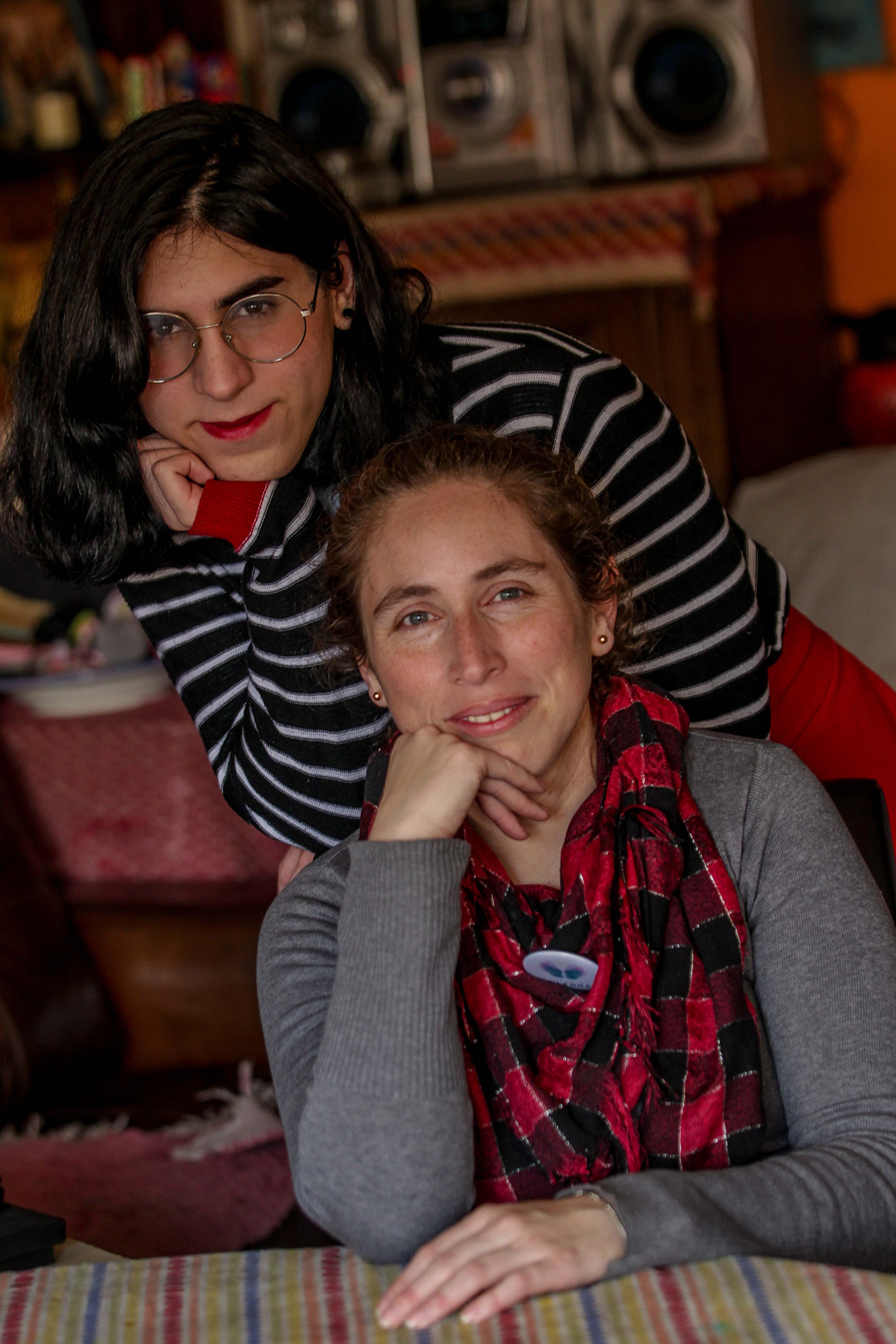
Como Ángela ha decidido permitir que su cuerpo se siga desarrollando, sabe que con el paso de la pubertad ciertos caracteres sexuales masculinos comenzarán a aparecer. De lo que diga la gente en la calle, o le vaya a pasar en el futuro, dice no tener miedo. A todo el mundo le puede pasar algo, y eso no va a detenerla, dice.
Son su mamá y su abuelo quienes se preguntan qué irá a pasar. Deben lidiar con los miedos, con las aprensiones. Cada cierto tiempo, Ximena termina enfrascada en algún intercambio porque alguien miró extraño o le dijo algo a Ángela. No puede evitarlo. Es una niña dice, su niña, y siente la necesidad de defenderla.
La joven no se da por aludida. A veces sí, cuando está más sensible, reconoce que las miradas la incomodan, pero rápidamente se olvida. Tiene cosas más importantes en que pensar. Le gustaría estudiar sicología o fotografía. ¿Familia? “Yo sola con animales. Conejos pueden ser. Quizás una pareja, pero nunca con hijos, no me imagino con hijos”.
Y bueno, como cualquier adolescente, Ángela también piensa en cosas no tan importantes.
“Me gusta mucho la música, el K-Pop. Me gusta mucho bailar. Hay una canción que se llama Time for the moon night, estoy como obsesionada con esa”.
Martín
Martín quiere jugar a la pelota sin polera. En la cancha de tierra donde juega con sus primos, Martín es el mejor. Martín escoge con quién jugar.

El problema es que, para todos los demás, Martín es Camila. Así que hay que ponerse la polera y dejar que los niños jueguen. Porque eso, eso no es para niñas, dice su mamá, y en un baile interminable, de ires y venires, Martín crece; sacándose la polera, poniéndose la polera, sacándose la polera, poniéndose la polera. Y siempre, volviendo a la cancha, sin entender por qué eso podría estar mal.
“Yo me sentía cómodo actuando como actuaba, pero todo el mundo lo rechazaba”, dice Martín, hoy de 30 años. Nunca una pelota de regalo, menos zapatos de fútbol. Solo patines rosados, tacitas para tomar el té y muñecas que se acumulaban al fondo de un clóset. Juntando polvo.
Apenas tuvo edad para hacer valer su voluntad, Martín desechó los colores pasteles y los vuelitos. “Peleaba, buscaba la ropa más masculina posible”. Ya a los 13 empezó a comprarse ropa de hombres. Era incómodo, confiesa, ir a probarse unos jeans, pero lo hacía igual, a pesar de sentir, a veces, un poco de vergüenza o de miedo. “Había un montón de otras cosas que me hubiera comprado, pero no me las iba a probar, así que desistía”.

Medallas. Unas ocho medallas cuelgan en la pieza de Martín como recuerdo de los mejores momentos de su adolescencia. Está ahí la del campeonato nacional de básquetbol de 2002, en Valdivia, que ganó con la selección del Liceo Carmela Carvajal. El básquetbol era su refugio, su excusa para ir con buzo todos los días al colegio y el deporte que lo acompañó durante su enseñanza media, “porque jugar fútbol… eso ni siquiera era una opción en el Carmela”, dice.
Jugar básquetbol y pololear. Ese era el fuerte de Martín en el liceo. Se ríe. Dice con orgullo (quizás más orgullo que el de las ocho medallas) que “le iba bien con las chiquillas”. Muchas, la mayoría, no eran lesbianas. Teoriza: quizás él generaba otra energía y ellas lo percibían.
Pero no siempre se sintió cómodo. “A veces no entendía nada”, dice, recordando cómo sus compañeras se maquillaban en el baño antes de salir de clases, para verse con los chicos de otros colegios. Por su comportamiento “poco femenino”, su profesora jefa le llamó al apoderado, para advertirle que Martín (Camila) se comportaba “rara”.
Al tiempo que la mayoría de sus amigas salían a juntarse con estudiantes del Instituto Nacional, el Lastarria o el Amunátegui, Martín decidía declararse lesbiana. Era el primer paso, el gesto primigenio de emancipación de todo lo que, sentía, había reprimido. Estaba en tercero medio y fue a su primera marcha gay.
Un mohicano
“Me quiero hacer un mohicano”, le dijo Martín a su hermano menor. Era julio de 2017 y manejaba camino al restaurante de sus papás, ubicado en Providencia. A pesar de ser invierno, el sol brillaba y se sentía especialmente optimista después de varios meses. En febrero había terminado una relación de ocho años y regresado a la casa de sus papás. Estaba atravesando una profunda depresión.
Martín se había titulado de ingeniero comercial luego de pasar por la carrera de piloto comercial. Su papá quería poner un local, el que Martín se ha dedicado a administrar desde entonces. “Le regalé el cartón a mi viejo, porque él siempre me ha protegido y ha estado conmigo”, dice. Su papá lo había aceptado como realmente era más que nadie. “Él me trató siempre como hombre, me llevaba a maestrear y me enseñaba todas esas cosas”.

“¡Dale!” -le respondió su hermano, cinco años menor- “anda a cortarte el pelo”.
Así que entró a la peluquería, una que estaba a solo pasos del local de sus papás. “Necesito un mohicano”, dijo. El peluquero lo quedó mirando con extrañeza, como preguntándose qué le había pasado. “¿Es la primera vez que te haces uno?”, le consultó. Martín le dijo que sí, con tono decidido. Entonces le pelaron ambos costados, dejándole el resto de su melena intacta.
Martín siente que ese fue el día en que empezó a transicionar.
- ¿Cómo reaccionó tu mamá?
- ¡Se le cayó el pelo! Pero ahí me di cuenta de que daba lo mismo lo que yo hiciera, se le iba a caer igual y yo tenía que vivir mi vida.
Fueron largos meses de terapia para entenderlo: “No era mi tarea hacerla sentir satisfecha, y nadie se iba a morir porque yo hiciera mi transición. Eso cuesta mucho aceptarlo, de verdad cuesta”, explica. Pero ya llevaba demasiado tiempo buscando excusas para postergarlo: salir del colegio, de la universidad, independizarse… “hasta que llega un punto en que no puedes más”.
El siguiente paso era contarlo. Le tomó alrededor de seis meses escribir una carta. “No me quería dispersar”, dice. La escribió, la acortó, y una tarde, cuando ya se sentía listo, reunió a toda la familia en el comedor. La leyó de corrido, aunque a ratos se le quebraba la voz. “Es más simple ponerse la carta al frente, leer, leer, que nadie te interrumpa, y después ves las reacciones”.

“Creo que todavía siente vergüenza”, dice Martín al hablar de su mamá. Es una mujer cerrada, de campo, nunca han tenido la mejor comunicación. Recién cuando tenía 22 años le dijo que era lesbiana y fue un enorme shock para ella. “Subí una foto a mi Facebook dándome un beso con mi polola. Me dijo ‘tú felicidad me hace daño’. ¿No se supone que los papás son felices cuando ven a sus hijos felices?”, se pregunta.
“Que la amo mucho y que espero que ella también me ame mucho a mí”.
En gestación
Ciento 70 mil pesos. Eso cuesta la dosis de hormonas que Martín se inyecta cada tres meses. La primera fue el 6 de febrero de este año, seis meses después de haberle leído la carta a su familia. Durante un par de semanas se había paseado con los folletos que le entregaron en la OTD (Asociación Organizando Trans Diversidades), donde recibió una asesoría sobre cómo transicionar.
“Vas al endocrinólogo, te pide unos exámenes, certificados sicológicos y siquiátricos. Si tienes la plata, el trámite es bastante sencillo”, explica. Los cambios se sienten rápidamente: el mentón, la voz, los pelos, el sudor… “tienes que ir adaptándote”. Quizás lo que más le ha llamado la atención es la impulsividad. “Es como tener 15 años de nuevo. A veces me miro y me da vergüenza enojarme tanto, o me da pena. El cambio hormonal es intenso”, explica.
Ya llevaba un tiempo buscando nombres. No quería pasar de Camila a Camilo, como muchos sugirieron. Si te vas a cambiar el nombre, que sea por uno que te guste, ¿no?, afirma. Hizo una lista en el celular que cada cierto tiempo miraba. “Descarté todos los religiosos, todos los del círculo familiar. Finalmente, escogí Martín y, cuando me llamaron por ese nombre, me llevó a mi infancia. Me gustó. Primera vez que me llenaba mi nombre”.
Su mamá le ha dicho Martín solo dos veces, “y cuando está enojada conmigo me dice Camila con más ganas”. Aún, si escucha que alguien lo llama por Camila, se voltea a mirar, pero ya lo hace también cuando le gritan Martín. Sus trabajadores, cuenta, corrigen a su mamá para que le diga por su nuevo nombre. Ya va a cumplir nueve meses de tratamiento hormonal, tiempo que decidió darle a su mamá para que se adapte al cambio. “A fin de cuentas, le está naciendo un nuevo hijo, entonces me pareció un tiempo razonable para que lo entienda y lo acepte”.
- ¿Y después?
- Después no sé si tendré tanta paciencia.
Al tiempo que comenzó a inyectarse hormonas, Martín empezó a pololear con Macarena Corvalán, técnico en enfermería de 21 años y a quien ya conocía hace seis. “La Maca me conoció como Camila, pero cuando le dije que iba a transicionar le hizo todo el sentido. Me ha apoyado mucho”, dice. De hecho, es quien le coloca las inyecciones de testosterona cada tres meses. Ella explica que siempre lo vio como hombre. “Recuerdo que cuando se cortó el pelo pensé ‘guau, se ve guapo’”.

La pareja posa en el patio de la casa de los papás de Martín. Macarena reflexiona sobre cómo él ha cambiado en estos meses. “Siento que con la transición su confianza ha aumentado, porque está siendo lo que siempre quiso ser. Conmigo se siente más libre y feliz, porque en su familia no todos han aceptado su cambio”.
“Es mi mamá y mi hermana, las mujeres de la familia, a las que les ha costado más”, acota Martín. Por mi hermano me he sentido muy apoyado.
- ¿Cómo ha
reaccionado tu papá? - Creo que para él ha sido muy… lógico. Él no tiene problemas, pero a veces siento que le resguarda mucho la burbuja a mi madre y eso me da rabia.
- ¿Te da rabia su actitud?
- Es que con las hormonas, todas las emociones se intensifican. ¡Hoy estoy lo más enojado que he estado en mi vida!
El acusete
El carné es el acusete, dice Martín. Si no fuera por él, la mayoría no se enteraría que alguna vez existió Camila. Le gusta poner a la gente a prueba, observar sus reacciones: sorpresa, vergüenza, molestia son las que más se repiten. Se negó a pasar por el engorroso trámite legal para cambiar su nombre y sexo registral, y espera hacerlo ahora, con la nueva Ley de Identidad de Género.

Cada día es un nuevo desafío. Ir al médico, por ejemplo, es complicado. “¿Tú crees que voy a ir al ginecólogo? Nunca sé cómo va a reaccionar el médico. Yo le pido a mi polola que me acompañe, entonces llaman a Camila Flores y me paro con ella, paso piola, pero por qué tiene que ser así”. Cuenta que ya tiene cotizada la mastectomía, pero está esperando terminar el proceso hormonal antes de considerar cualquier otra intervención.
Hace unos meses quería hacer una reparación en el restaurante y fue a comprar un saco de cemento al Sodimac. “Yo siempre me las arreglé sola, incluso de Camila, pero no tengo la fuerza que tiene un hombre para subir un saco de cemento al auto”. ¿Cómo pedirle ayuda a alguien, siendo hombre? No podía, explica. “Ahí lo subí, arrastrando, pero lo logré”.
Es que Martín no quiere ser “un hombre”. “Me defino como un hombre trans y un feminista arraigado, porque yo viví el machismo en carne propia. Cuando niño reclamaba por qué no podía jugar a la pelota, si yo jugaba la raja. ¿Solo por ser mujer? Eso me ayudó a entender el feminismo”.
Por supuesto, hay momentos graciosos. Como cuando lo llaman para cobrarle o venderle cosas.
- Aló, señorita, Camila.
- Sí, con él…
“Y me cortan. Deben creer que los estoy molestando, pensarán que le robaron el teléfono a Camila. Así que no me cobran, ni me venden nada”.


